
State store
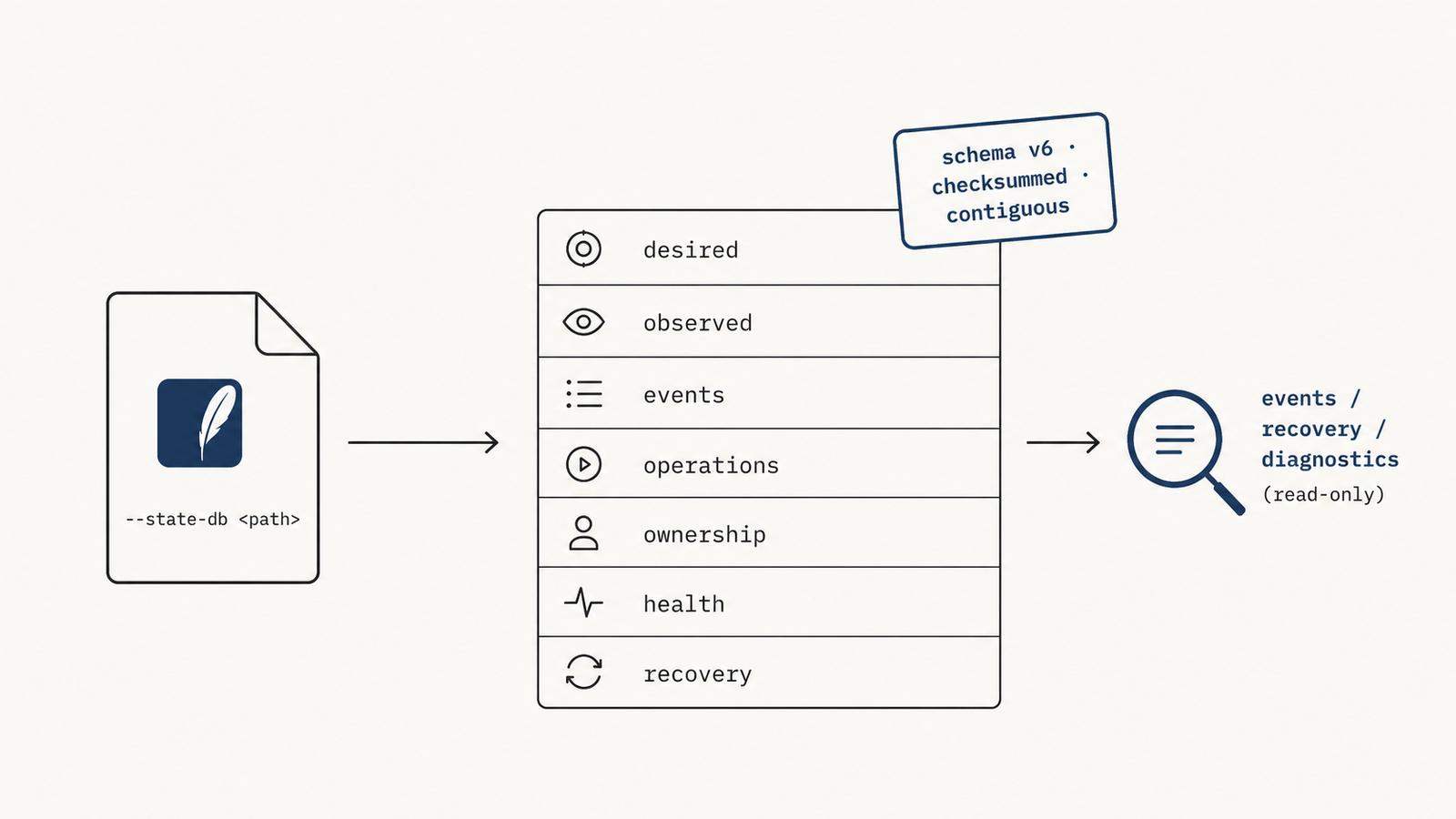
Hostwright’s local state store is SQLite, using the system SQLite3 library
with zero external dependencies. It persists desired-state snapshots, observed runtime
snapshots, the event ledger, operation records, ownership records, health
results, restart policy state, restart recovery records, and operation recovery
groups with step-level checkpoints.
Explicit paths only
Section titled “Explicit paths only”Hostwright never chooses a database path for you. There is no default under
the repository, ~/Library/Application Support, XDG paths, or any global
location. Every stateful command takes --state-db <path>:
hostwright status --state-db /tmp/hostwright.sqlitehostwright events --state-db /tmp/hostwright.sqliteWrite-path commands (status, logs --state-db, apply, cleanup,
hostwrightd --foreground) can run explicit migrations before writing.
Read-only commands (events, recovery, diagnostics) validate the
already-applied schema and fail rather than creating or migrating a database
as a side effect.
Migration continuity
Section titled “Migration continuity”Migrations are explicit and checksummed:
- Schema version 6 is the latest supported version. A database migrated by a newer Hostwright release fails closed with an incompatible-schema error; Hostwright does not downgrade or convert.
- Each migration records a checksum in
schema_migrations. A known version with an unexpected checksum fails before any application reads or writes. - Applied migration history must be a contiguous prefix starting at version 1. A database recording a later migration while omitting an earlier one fails closed. A valid older contiguous prefix remains eligible for explicit forward migration.
Schema version 6 added exact observed resource identifiers, observed network metadata, and ownership identity versions; legacy rows are backfilled as identity version 1, new labeled resources are written as version 2. See Runtime adapter: identity and ownership.
What is (and is not) stored
Section titled “What is (and is not) stored”Normalized columns hold identifiers, project and service names, timestamps, lifecycle states, operation status, event severity, restart status, recovery checkpoints, lock leases, and hashes. JSON blobs hold ports, networks, mounts, environment snapshots, event and operation payloads, and recovery metadata, all redacted before persistence.
Concurrency
Section titled “Concurrency”The contract is single-writer: one CLI command or daemon may write a state
database at a time. Hostwright uses SQLite full-mutex mode, a bounded busy
timeout, and BEGIN IMMEDIATE transactions. If another process holds a write
lock beyond the timeout, Hostwright reports a locked database instead of
waiting indefinitely. Operation-group acquisition is atomic across concurrent
stores, with exactly one winner.
No transaction performs runtime mutation. Apply and cleanup write intent first, leave the transaction, call the RuntimeAdapter, then record success or failure.
Backup and restore are cold operations
Section titled “Backup and restore are cold operations”- Stop any Hostwright command or daemon using the database.
- Copy the explicit SQLite file plus sidecars (
*-wal,*-shm) if present. - To restore: move the existing database aside (never overwrite), copy the
backup into place, and verify with a safe read such as
hostwright events --state-db <path>.
There are no online backup, restore, or repair commands, and no production durability guarantee. Corruption recovery is manual: keep the file, restore from a cold backup, or start a new explicit path. Hostwright never invents ownership records or erases state automatically.