
Reconciliation
Reconciliation is Hostwright’s core loop: deterministic, observable, and designed to fail closed.
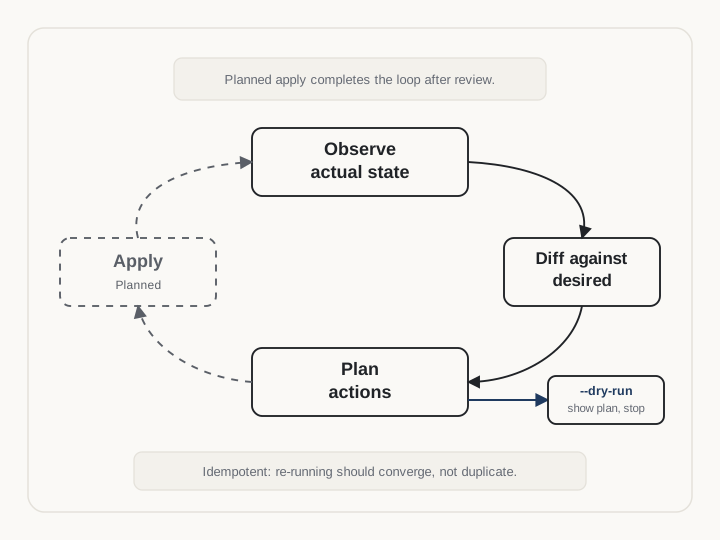
The loop
Section titled “The loop”- Load desired state from the manifest.
- Observe runtime state through the RuntimeAdapter.
- Compute drift.
- Produce a dry-run plan with a deterministic hash.
- Apply only through the confirmed single-action persistence gate.
- Record events.
The planner maps the supported manifest subset to runtime-shaped desired state, accepts optional adapter-shaped observed state, runs policy checks, and emits typed drift records, typed issues, typed planned actions, and a deterministic plan hash.
Plan and apply are separate commands
Section titled “Plan and apply are separate commands”hostwright planrenders desired-state and policy diagnostics. It does not perform live runtime observation by default, and it says so explicitly in its output.hostwright applyrecomputes the plan against a live observation, requires a matching--confirm-planhash, persists operation intent before mutation, and executes exactly one executable action:createMissingService, a restart-policy-allowedstartManagedService, or a restart-policy-allowedrestartManagedService.hostwright cleanupis separate from apply, with its own dry-run token gate. See the safety model.hostwrightd --foregroundruns the observe, plan, and record loop continuously. Mutation stays with the apply gate. See Daemon.
Drift cases
Section titled “Drift cases”The planner detects:
- missing desired services;
- unmanaged observed services;
- stopped, exited, failed, and missing lifecycle states;
- image drift, port drift, mount drift;
- unhealthy or unknown health state where policy requires health;
- duplicate observed identities;
- unsupported unknown observed lifecycle states;
- unavailable observation.
Only createMissingService and the restart-policy-allowed start/restart
actions can be marked executable. Every other action is rendered as
unavailable: visible in the plan and blocked from execution.
Correctness requirements
Section titled “Correctness requirements”- Planning is deterministic: same inputs, same plan, same hash.
- Desired state and observed state remain separate inputs.
- Drift must be explainable: every record carries a typed reason.
- Plan rendering must not expose raw secrets.
- Mutation must require plan-hash confirmation.
- Operation intent must be persisted before mutation.
- Failures must be observable through events.
- Managed restart requires Hostwright ownership, live observed running state, a fresh persisted unhealthy health result, and recovery records.