
Secrets and Keychain
Hostwright supports a narrow manifest secret-reference model. The manifest stores a reference label, never a secret value:
services: api: image: ghcr.io/example/api@sha256:... secretEnv: API_TOKEN: keychain://hostwright.api/api-token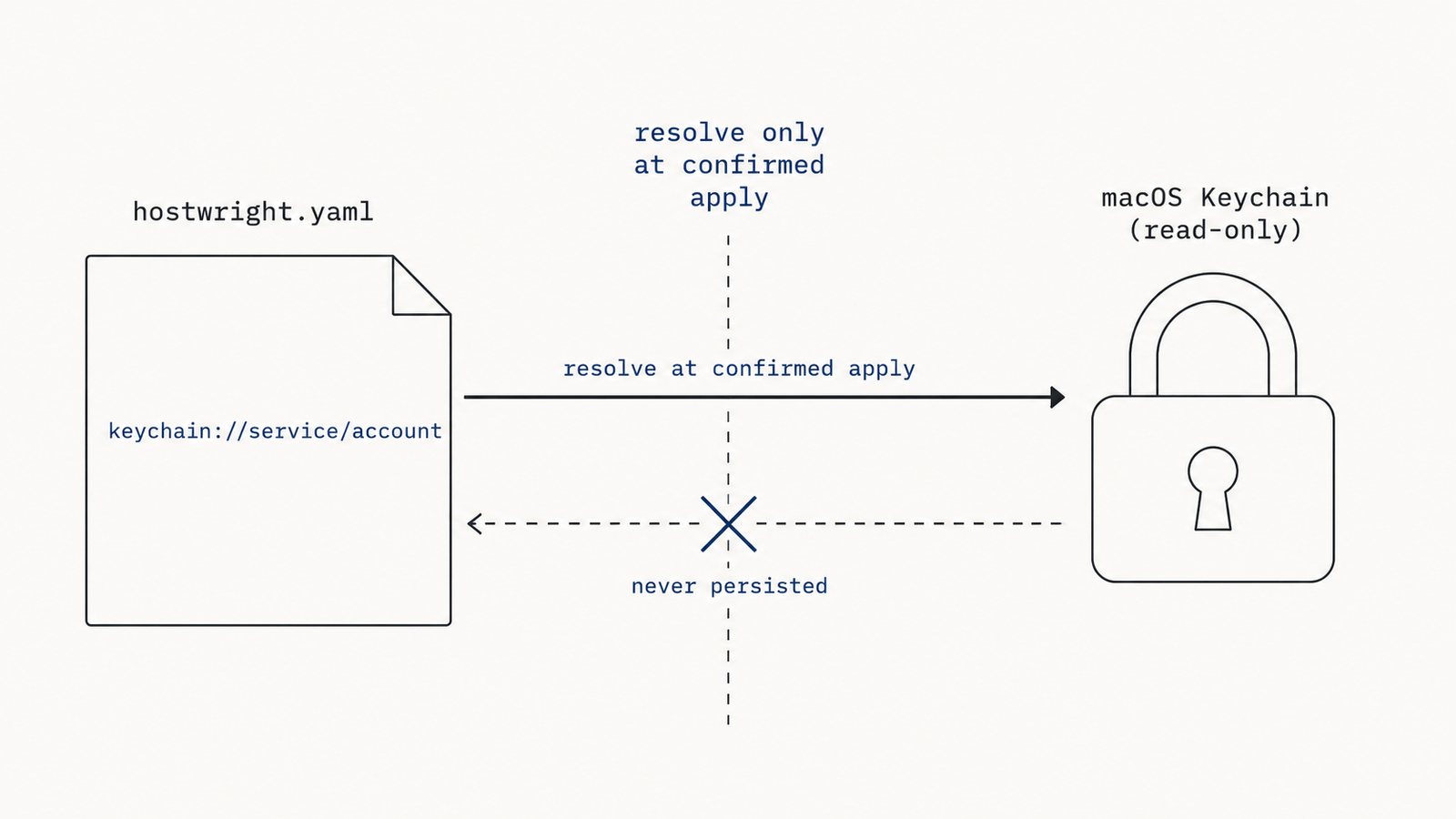
Rules enforced by validation:
- Plaintext sensitive keys under
envfail validation. secretEnvvalues must usekeychain://<service>/<account>.- The same key cannot appear in both
envandsecretEnv.
When references resolve
Section titled “When references resolve”Planning, status, state persistence, diagnostics, events, and errors see only redacted secret-reference metadata. A confirmed create action resolves references immediately before calling the runtime mutation hook. If no approved backend resolves the reference, apply fails before mutation.
Hostwright also redacts the keychain reference labels themselves, because a service/account name can reveal local context, so it never appears in plans, state rows, diagnostics bundles, or error messages.
The macOS Keychain backend
Section titled “The macOS Keychain backend”MacOSKeychainSecretStore is a read-only production backend for local
generic-password items. It:
- queries an exact service/account pair only;
- excludes synchronizable (iCloud-synced) items;
- disables authentication UI, so CLI processes run without Keychain prompts.
Its live integration gate creates a unique real Keychain item, resolves it, deletes it, and verifies the second lookup fails, with the gate required to run in full. A malformed-data case proves non-UTF-8 item data fails without exposing the service, account, or bytes.
Out of scope
Section titled “Out of scope”Rejected The following are rejected:
- plaintext secret persistence in state, events, or diagnostics;
- Keychain writes/deletes, prompts, access groups, or synchronizable items;
- provider credentials, cloud secret managers, registry credential storage, credential sync, or credential upload;
- mounted secret files, multiline secret payloads, binary secret blobs;
- Compose/Kubernetes
secrets:compatibility.
See State store for the persistence boundary and Security and safety for the wider posture.