
Safety model
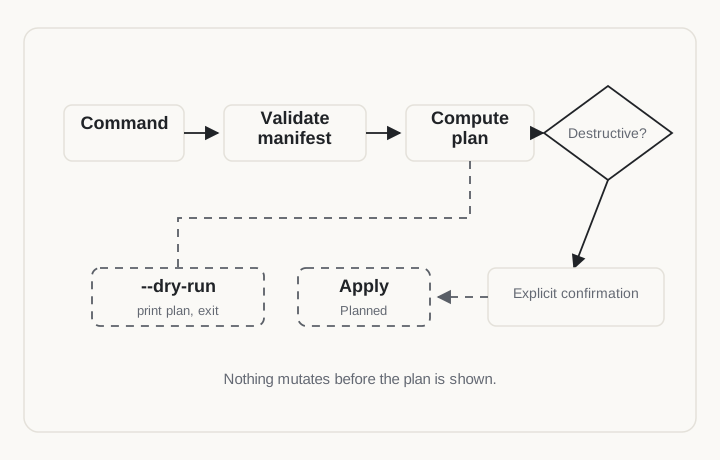
Hostwright’s safety posture is conservative and enforced by the command surface: the runtime can be mutated only through two explicit, confirmed gates.
Principles
Section titled “Principles”- Plan before mutation.
applyrecomputes the plan against a live observation and refuses to run unless your--confirm-plan <hash>matches it. - One action per apply. Exactly one executable action runs per invocation; create a missing service, or a restart-policy-allowed managed start or restart. Zero executable actions refuses; more than one refuses.
- Dry-run before deletion.
cleanup --dry-runclassifies every candidate and prints an exact confirmation token. Only--confirm-cleanup <token>with that token deletes anything. - Intent before mutation. Operation intent, recovery groups, and checkpoints are persisted to the explicit state database before the runtime is touched.
- Conservative validation. Unsafe or ambiguous manifests are refused, not refused. See the policy engine.
- Ownership-tracked cleanup. No broad garbage collection. Cleanup touches only resources Hostwright can prove it owns.
- No secret leakage. Plans, events, logs, state rows, and errors carry redacted values only.
The apply gate, concretely
Section titled “The apply gate, concretely”hostwright apply refuses mutation when, among other cases, the state
database or plan hash is missing or mismatched, observation fails, the plan has
blockers, zero or multiple executable actions exist, a create action uses
mounts or privileged ports or broad bind addresses, the local image cannot be
confirmed, or another operation still holds an active lease. Created port
bindings are published to 127.0.0.1 explicitly. A managed restart
additionally requires exact Hostwright ownership, live observed running state,
and a fresh persisted unhealthy health result.
An interrupted operation can reuse its plan only when the persisted checkpoint
proves runtime execution never began. Anything ambiguous stays blocked and is
reported by hostwright recovery.
Ownership
Section titled “Ownership”Hostwright distinguishes resources it created from resources you created by hand. Hostwright-created containers carry versioned identifiers and exact ownership labels, mirrored by ownership records in the state store. The rule is strict: cleanup never deletes a resource it cannot prove Hostwright owns.
Cleanup classifications from the dry run: eligible, ambiguous, stale,
running (never deleted), unknown, blocked, and never-delete. Only
eligible (an exact Hostwright-owned created/stopped/exited container covered
by the current token) is ever deleted. Images, volumes, networks, and
unmanaged containers are never touched, and broad flags like --all or
--force are never used.
Secrets
Section titled “Secrets”Secrets are not committed into manifests. Plaintext sensitive keys under env
fail validation; secret values enter only through
keychain:// references resolved at the
last moment before a confirmed create.